What Happens When HOA Rules Conflict?
Every HOA is governed by a stack of documents: state statutes, CC&Rs, bylaws, and rules & regulations. Each one was written by different people, at different times, for different purposes. So it should surprise no one that they sometimes disagree.
When they do, someone gets hurt. A homeowner gets fined under a rule that a higher document contradicts. A board denies an architectural request based on language that was superseded years ago. An enforcement action falls apart because the rule it relied on doesn't hold up.
Understanding which document wins isn't academic. It's the difference between enforceable governance and expensive mistakes.
The document hierarchy
HOA governing documents follow a strict pecking order. When two documents conflict, the higher-ranking one prevails:
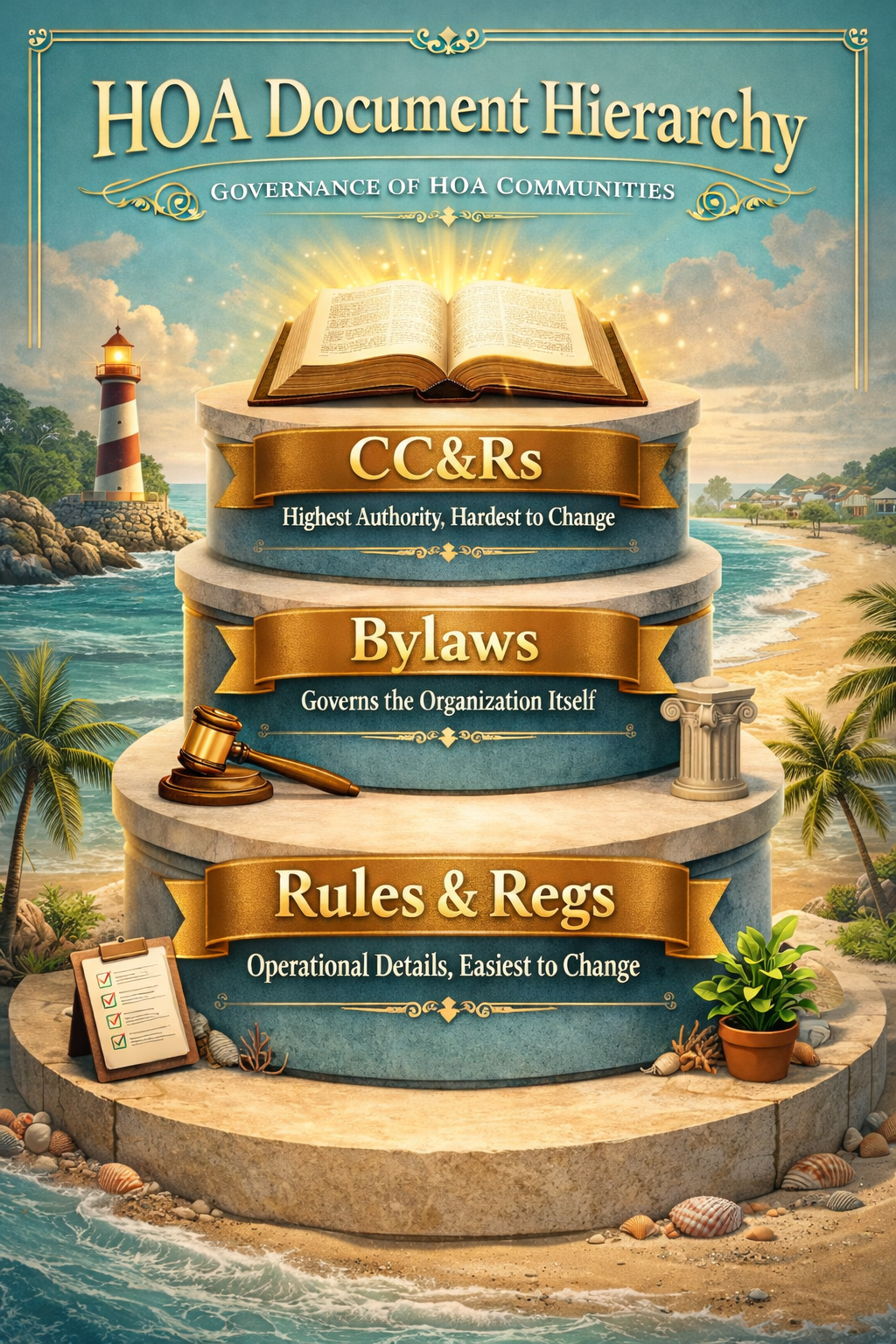
Above the community-level documents sits state and federal law — always at the top. No HOA document can override a statute.
This hierarchy isn't a suggestion. Courts enforce it. If a rule contradicts the CC&Rs, the CC&Rs control. If the CC&Rs contradict state law, the statute controls. No board resolution or committee vote changes that order.
Real-world conflicts
These aren't hypotheticals. They happen in communities every day.
CC&Rs vs. rules and regulations
The CC&Rs allow fences up to six feet. The board later adopts a rule limiting fences to four feet. A homeowner builds a five-foot fence and gets a violation notice.
The CC&Rs win. The board cannot use rules and regulations to impose a stricter standard than what the CC&Rs permit. The homeowner's five-foot fence is compliant. The violation doesn't hold up.
Bylaws vs. state law
The bylaws say board meetings require 48 hours' advance notice to homeowners. State law — say, California's Davis-Stirling Act — requires 10 days for certain meeting types.
State law wins. The board that provides only 48 hours' notice has violated the statute, regardless of what the bylaws say. Decisions made at that meeting could be challenged and voided.
CC&Rs silent, board acts anyway
The CC&Rs say nothing about short-term rentals. The board passes a rule banning them outright.
This is legally questionable. Rules and regulations derive their authority from the CC&Rs. If the CC&Rs don't address a topic or don't grant the board authority to regulate it, a board-adopted rule banning it stands on shaky ground. Some courts uphold broad "general welfare" authority; others don't. Homeowners who challenge these rules often win.
When a document contradicts itself
Sometimes the conflict isn't between two different documents — it's within the same one. Section 3 of the CC&Rs says exterior paint requires Architectural Review Committee (ARC) approval. Section 7 says homeowners may maintain their property's exterior appearance without restriction.
Courts resolve internal contradictions using three principles:
- The more specific provision controls. If Section 3 specifically addresses paint colors and Section 7 speaks generally about "maintenance," Section 3 governs paint decisions.
- The later-adopted provision may control. If the CC&Rs were amended and the amendment conflicts with an original section, the amendment typically prevails — it reflects the community's more recent intent.
- Drafter's intent matters. Courts look at the document as a whole to determine what the original drafters were trying to accomplish. Isolated sentences don't override the document's overall structure and purpose.
None of these principles are bright-line rules. They require interpretation, which means they require legal judgment — and sometimes litigation.
Amendments make it worse
Amendments are the most common source of hidden conflicts. An association amends Section 5 to update architectural standards but doesn't revisit Section 12, which contains a related provision about exterior modifications. Now Section 5 says one thing and Section 12 says another.
This happens because amendments are drafted narrowly. The attorney or board focuses on the specific section being changed without cross-referencing every other provision that might be affected. Over decades, with multiple amendments adopted by different boards, the CC&Rs accumulate contradictions that no one notices — until someone tries to enforce one of the conflicting provisions.
The real problem: no one finds the conflict until it's too late
Most boards don't discover a conflict by reading their documents carefully. They discover it when a homeowner pushes back on an enforcement action, when an attorney reviews the documents during a dispute, or when an insurance carrier flags a liability issue.
By that point, the damage is done. The board has already sent the violation letter, already denied the architectural application, already assessed the fine. Walking it back is embarrassing at best and creates legal exposure at worst.
What boards should do
Conduct periodic document reviews with legal counsel. Not just when a dispute arises — proactively. After every amendment, have counsel review the full CC&Rs for internal consistency. Every few years, review the entire document stack: CC&Rs, bylaws, and rules side by side.
Don't assume your rules are valid. Every rule the board adopts should be checked against the CC&Rs and state law before it's enforced. "The board approved it" is not the same as "it's legally enforceable."
Track what was amended and when. Maintain a clean, consolidated version of the CC&Rs that incorporates all amendments. Working from a patchwork of the original document plus separate amendment pages is a recipe for missing conflicts.
What homeowners should do
Check all three tiers. When you receive a violation notice or a denial from the ARC, don't just read the rule they cited. Read the CC&Rs. Check the bylaws if the issue involves procedure. Look up your state's HOA statute. The rule they're enforcing may be contradicted by a higher-authority document.
Ask for the specific provision. Boards should be able to cite the exact section and document that supports their action. If they can't — or if the section they cite doesn't say what they claim — that's a red flag.
Put it in writing. If you believe a conflict exists, document it in a letter to the board. Cite the specific provisions. Boards take written, well-sourced objections more seriously than verbal complaints at a meeting.
Why this matters
Acting on the wrong document has real consequences. Fines issued under an unenforceable rule don't hold up in court. ARC decisions based on superseded provisions get reversed on appeal. Boards that enforce contradictory rules expose the association to legal liability — and that liability gets paid out of every homeowner's assessments.
Conflicting rules aren't just a legal technicality. They erode trust. Homeowners who get fined under a rule that turns out to be invalid don't walk away thinking "the system works." They walk away thinking the board is either incompetent or acting in bad faith. Neither is good for the community.
The fix isn't complicated, but it does require diligence: know your documents, know the hierarchy, and when something doesn't add up, dig deeper.
When your governing documents span hundreds of pages across multiple files, conflicts hide in plain sight. SayWhat searches all your documents at once — so when the answer is in Section 7.4 of the CC&Rs instead of the rules your board cited, you'll know. See how it works.
← Back to Blog